
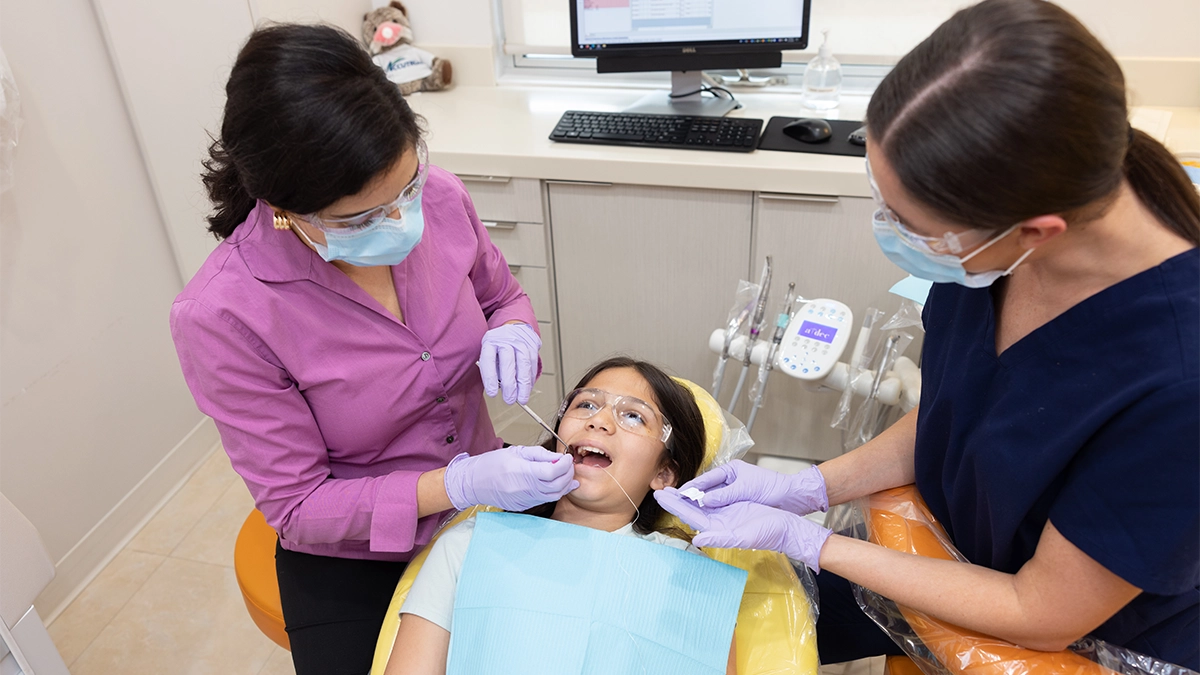

Finding out your child has a cavity is stressful enough. Silver diamine fluoride offers a meaningful alternative for many situations — a liquid applied directly to a cavity in seconds, with no drilling, no needles, and no removal of tooth structure. For children who are too young to cooperate with traditional restorative treatment, who have multiple cavities that cannot all be addressed in one visit, or who experience significant anxiety, SDF changes what is possible in a single appointment. At Little Bytes Pediatric Dentistry in Palo Alto, SDF is one of several minimally invasive dentistry approaches we use as part of a comprehensive, child-centered pediatric dental services model.
Dr. Michelle Haghpanah and Dr. Reena Grover are board-certified pediatric dentists who evaluate every cavity individually and discuss all available treatment options with parents clearly before moving forward. Silver diamine fluoride is not the right choice for every situation, and our team is transparent about both what it can accomplish and where other treatments are more appropriate. The goal is always the option that best protects your child’s tooth and fits the reality of their age, cooperation level, and overall dental health.
Silver diamine fluoride is an FDA-approved liquid medication used to arrest active tooth decay. It contains two active components that work together: silver, which kills the bacteria responsible for causing cavities and hardens the softened dentin affected by decay, and fluoride, which remineralizes weakened enamel and makes the tooth structure more resistant to further acid attack. When applied to an active cavity, SDF penetrates the decayed tissue and effectively stops the progression of decay without removing any tooth structure. The treated cavity does not disappear, but it stops getting worse, and the tooth is stabilized until a definitive restoration can be placed or until the primary tooth naturally falls out.
The application itself is simple and takes only a few minutes. The affected tooth is isolated and dried, and a small amount of SDF solution is applied directly to the cavity surface using a microbrush. No drilling, no anesthesia, and no extended time in the chair are required. The AAPD recognizes silver diamine fluoride as a valuable tool in caries management for pediatric patients, particularly as part of a broader ongoing care plan rather than as a standalone solution.
Understanding the tradeoffs between SDF and conventional fillings helps parents make the right decision for their child’s specific situation. The table below outlines the key differences.
| Silver Diamine Fluoride | Traditional Filling | |
|---|---|---|
| Drilling required | No | Yes |
| Anesthesia typically needed | No | Usually yes |
| Time in chair | Minutes | 30 to 60 minutes |
| Removes decay | No — arrests it | Yes |
| Restores tooth function/shape | No | Yes |
| Effect on tooth appearance | Treated area stains black | Tooth-colored or metal restoration |
| Best for | Young children, anxious patients, multiple cavities, non-cooperative patients | Cavities requiring structural restoration, permanent teeth, aesthetic priority |
| Requires follow-up treatment | Often — filling or crown later | Not typically |
Neither option is universally better. SDF is the right choice when arresting decay is the priority and immediate restoration is not practical or appropriate. A conventional filling is the right choice when decay has progressed to a point where the tooth’s function or structure needs to be restored, when the cavity is on a tooth visible in the smile, or when the patient can cooperate with the procedure. In many cases, SDF is used as a bridge — stabilizing a cavity until a child is old enough or cooperative enough for a filling or Hall crown technique.
SDF is particularly well suited to specific patient situations. Children under age three who have early childhood caries and cannot safely tolerate conventional restorative treatment are among the clearest candidates. Children with multiple active cavities across several teeth, where treating all of them in a single conventional visit would be impractical or require significant sedation, benefit from SDF as a first step to stabilize decay across all affected teeth. Children with significant dental anxiety who have not yet built enough trust to sit through drilling and injections can have their cavities arrested with SDF while that trust develops over time. Children with special health care needs, for whom the demands of conventional treatment present genuine challenges, are another group for whom SDF provides meaningful access to effective care.
SDF is not appropriate for all patients. It cannot be used in patients with a known silver allergy. Patients with open oral sores, advanced gum disease, or decay that has extended through the enamel and into the pulp of the tooth are not good candidates. Our team evaluates each child’s clinical picture before recommending SDF and ensures parents understand both the indication and the limitations specific to their child’s case.
The most significant cosmetic consideration with SDF is that treated cavities turn black. This happens because the silver component reacts with decayed tooth structure and causes permanent dark staining in the area where decay was present. Healthy tooth structure is not affected and does not change color. For back teeth, most parents find the staining acceptable, particularly when weighed against the alternative of a difficult procedure for a young child. For front teeth, the staining is more visible and is a real consideration in the decision-making process.
The staining can be addressed later. Once a child is ready for conventional treatment, placing a tooth-colored restoration over the arrested cavity covers the black area and restores the appearance of the tooth. The staining is therefore a temporary cosmetic issue for many patients rather than a permanent outcome, though it will remain visible until covered by a restoration.

SDF is not a one-time fix that ends the conversation about a tooth. Treated teeth are monitored at every subsequent visit to confirm that decay has been successfully arrested and is not progressing. If decay continues despite SDF, further treatment is needed. A second application of SDF may be appropriate, or the clinical situation may require escalation to a filling, extraction, or other intervention. Ongoing preventive dental care — including regular exams, professional cleanings, and fluoride treatments — remains essential after SDF treatment to protect both treated and untreated teeth from new decay.
Most primary teeth treated with SDF will eventually be followed by a restoration or will be lost naturally as permanent teeth erupt. The goal of SDF is not to eliminate the need for future dental care but to buy time, reduce the need for multiple appointments under sedation, and keep a young child’s experience with dentistry as positive as possible during the years when those experiences shape how they feel about dental care for life.

No. SDF is applied with a small brush and takes only seconds per tooth. No injection, no drilling, and no removal of tooth structure are involved. Most children tolerate the application without any distress. There may be a brief metallic taste that disappears quickly.
The area of active decay that is treated with SDF will turn black. Healthy tooth structure is not affected. For back teeth this is rarely a cosmetic concern. For front teeth it is a real consideration, and our team discusses this clearly with parents before applying SDF so families can make an informed choice.
SDF arrests the cavity — it stops the decay from progressing — but it does not remove the decayed tissue or restore the shape and function of the tooth. Depending on the tooth and the child’s age, a filling or crown may be recommended as a follow-up once the child is cooperative enough or when the tooth requires structural restoration.
Coverage varies by plan. Many dental insurance plans do provide some level of coverage for SDF, particularly for pediatric patients. Our team is happy to help families review their benefits before the appointment.
Please complete and submit the form and a member of our staff will contact you shortly.
"*" indicates required fields
Location & Hours
We use cookies to improve your experience on our site. By using our site, you consent to cookies.
Manage your cookie preferences below:
Essential cookies enable basic functions and are necessary for the proper function of the website.
CloudFlare provides web performance and security solutions, enhancing site speed and protecting against threats.
Service URL: developers.cloudflare.com (opens in a new window)
These cookies are needed for adding comments on this website.
Google reCAPTCHA helps protect websites from spam and abuse by verifying user interactions through challenges.
Google Tag Manager simplifies the management of marketing tags on your website without code changes.
Statistics cookies collect information anonymously. This information helps us understand how visitors use our website.
Google Analytics is a powerful tool that tracks and analyzes website traffic for informed marketing decisions.
Service URL: policies.google.com (opens in a new window)
Marketing cookies are used to follow visitors to websites. The intention is to show ads that are relevant and engaging to the individual user.
Google Maps is a web mapping service providing satellite imagery, real-time navigation, and location-based information.
Service URL: policies.google.com (opens in a new window)