


Medically reviewed by
Dr. Michelle Haghpanah, DDS, MPH
Board-Certified Pediatric Dentist
Dr. Michelle Haghpanah is a board-certified pediatric dentist dedicated to providing preventive, evidence-based dental care for infants, children, and adolescents. She earned her Doctor of Dental Surgery from New York University, a Master of Public Health from Yale University, and completed her pediatric dental residency at Mount Sinai Medical Center, where she served as Chief Resident. A former Associate Professor at the University of the Pacific with hospital privileges at Lucile Packard Children’s Hospital Stanford and Kaiser Santa Clara, Dr. Michelle reviews clinical content to ensure it reflects current pediatric dental guidelines, evidence-based practices, and clear, family-friendly information that helps parents make informed decisions about their child’s oral health.
When a new baby struggles to latch, gains weight slowly, or seems unusually fussy during feedings, most parents look first to milk supply, positioning, or general newborn difficulty as the explanation. Lip tie is rarely on that list, and for many families, it never makes it there at all. Yet this small, often overlooked tissue restriction can be a meaningful contributor to feeding challenges in infants and early dental development concerns in toddlers.
At Little Bytes Pediatric Dentistry in Palo Alto, our board-certified pediatric dentists offer minimally invasive treatment for lip tie using advanced laser technology. We treat this as a priority area of care, particularly for families with newborns, where early identification and gentle treatment can make a significant difference in both feeding outcomes and long-term oral development.
What a Lip Tie Is and Why It Often Goes Unnoticed
A lip tie occurs when the labial frenulum, the tissue connecting the inner upper lip to the gum above the front teeth, is too tight or short to allow normal lip movement. During breastfeeding, an infant depends on that mobility to form a wide, effective seal. When the frenulum is overly restrictive, the latch becomes shallow and effortful, which can affect how efficiently a baby feeds and how comfortably feeding progresses for both infant and mother.
Part of why lip tie goes undetected is that it is not consistently screened for in routine newborn evaluations, and its symptoms are easy to attribute to other causes. A baby who gains weight slowly or nurses constantly may simply be described as a difficult feeder. In toddlers, a tight frenulum can contribute to a visible gap between the upper front teeth and make gumline hygiene more difficult. Still, neither finding typically prompts parents to seek a dental evaluation on its own.
Signs Worth Paying Attention To
Some of the following patterns in infants and toddlers may suggest a lip tie that is worth evaluating with a pediatric dentist. Common signs include the following:
- Difficulty latching or maintaining a deep latch during breastfeeding
- Frequent nursing sessions paired with slow or poor weight gain
- Clicking, popping, or slipping during feeds
- A visible gap between the upper front teeth in toddlers
- Plaque buildup or difficulty cleaning along the upper gumline
Any of these signs is worth raising during a dental evaluation, especially in the first weeks of life or when combined with a known tongue-tie.
How Lip Tie Can Affect Development
Research published by the National Institutes of Health identifies lip tie as an underrecognized cause of breastfeeding difficulty. It suggests that frenotomy is an effective treatment, with all mothers in the study reporting improved ease of breastfeeding following the procedure. Beyond infancy, an unaddressed restriction can affect the development of the upper lip muscles, contribute to dental spacing concerns, and create areas that are harder to keep clean as the primary teeth emerge.
Lip tie also frequently occurs alongside tongue tie, and in children with tongue tie, the two restrictions can compound each other’s effects on feeding and oral development. In some children, untreated oral restrictions also set the stage for airway and jaw development concerns that we address through programs like HealthyStart.
How Lip Tie Is Treated
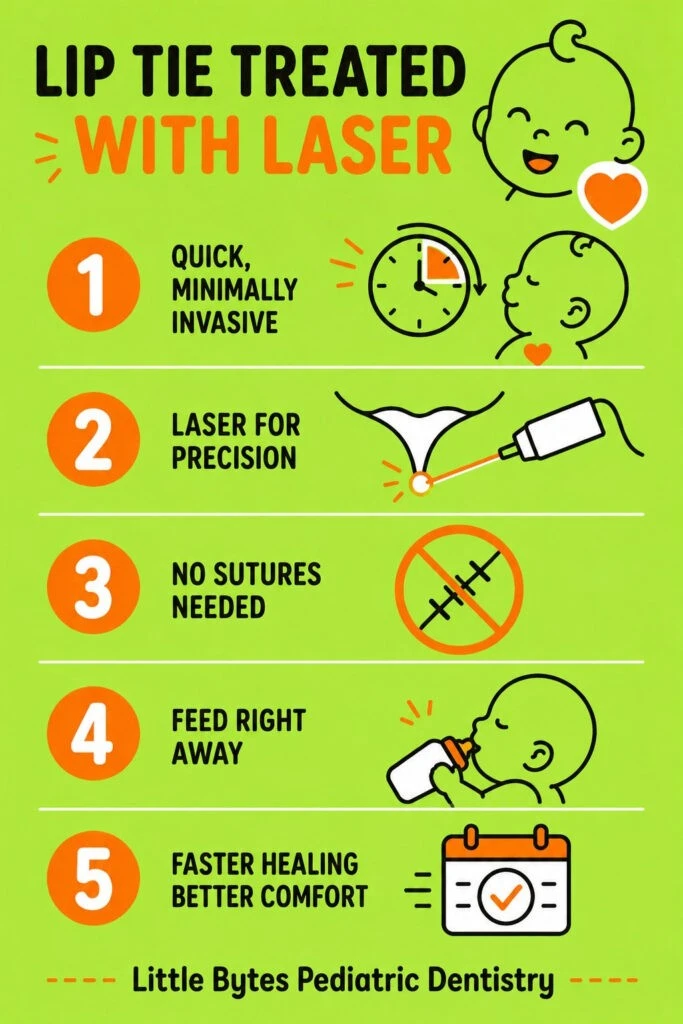
Lip tie release, or labial frenotomy, is a brief and minimally invasive procedure. At Little Bytes, we use laser technology to precisely and efficiently release the frenulum, with minimal discomfort and a fast recovery. No sutures are required, and infants can typically feed immediately after the procedure. The laser allows for high precision, reduces the risk of bleeding, and shortens recovery time compared to traditional methods.
Our approach to prevention and education means we walk every family through exactly what to expect before, during, and after treatment. We take care to answer every question you have along the way, and our team remains available as your child recovers so that the process feels as straightforward and stress-free as possible.
Your Child’s Care Starts Early at Little Bytes Pediatric Dentistry
Our board-certified pediatric dentists in Palo Alto have completed extensive training through residency and volunteer outreach programs and hold privileges at Lucile Packard Children’s Hospital at Stanford and Kaiser Santa Clara. We combine the latest dental technology, including intraoral cameras and digital X-rays, with a warm, child-friendly environment designed to make every visit feel approachable for young patients and their families.
If your infant or toddler is showing signs of a feeding difficulty, a dental gap, or an unexplained restriction, we encourage you to schedule an evaluation sooner rather than later. Contact our office to book an appointment, and let our team take a thorough look at what may be behind the challenge and how we can help.