

Medically reviewed by
Dr. Michelle Haghpanah, DDS, MPH
Board-Certified Pediatric Dentist
Dr. Michelle Haghpanah is a board-certified pediatric dentist dedicated to providing preventive, evidence-based dental care for infants, children, and adolescents. She earned her Doctor of Dental Surgery from New York University, a Master of Public Health from Yale University, and completed her pediatric dental residency at Mount Sinai Medical Center, where she served as Chief Resident. A former Associate Professor at the University of the Pacific with hospital privileges at Lucile Packard Children’s Hospital Stanford and Kaiser Santa Clara, Dr. Michelle reviews clinical content to ensure it reflects current pediatric dental guidelines, evidence-based practices, and clear, family-friendly information that helps parents make informed decisions about their child’s oral health.
When your child’s teeth start coming in crowded, or you notice early jaw development concerns, the orthodontic conversation arrives sooner than most parents expect. Today, the path forward is not limited to a single option. For many families, the choice between HealthyStart and traditional braces is one of the most important decisions in a child’s dental journey, and understanding the difference between these two approaches helps you make the right call.
At Little Bytes Pediatric Dentistry in Palo Alto, our board-certified pediatric dentists offer pediatric orthodontic solutions tailored to each child’s stage of development. We take the time to explain every option, answer your questions, and build a treatment plan that prioritizes your child’s long-term health.
Two Different Approaches to Straighter Teeth
Traditional braces use fixed metal or ceramic brackets bonded to the teeth and connected by wires that are periodically adjusted to shift teeth into alignment. They are effective at correcting moderate-to-severe crowding, misalignment, and bite issues and are typically introduced once most of a child’s permanent teeth have erupted. For many teens, traditional braces remain among the most reliable tools for addressing complex alignment concerns.
HealthyStart takes a fundamentally different path. Rather than mechanically moving teeth once they have erupted in the wrong position, a myofunctional system uses custom removable appliances worn primarily during sleep to guide jaw and airway development during childhood. It targets the underlying habits and structural patterns, such as mouth breathing and poor tongue posture, that cause misalignment in the first place.
The Role of Age and Timing
The most significant practical difference between these two options is the age range each is designed for. HealthyStart is suited for children as young as two and is most effective through age 12, during the growth window when the jaw and airway are still being shaped. Addressing structural patterns during this period lets a dentist guide development rather than correct it after the fact.
Research published by the National Institutes of Health found that early orthodontic intervention can significantly improve skeletal development, arch dimensions, and airway space in children. They also found that it may reduce the need for extractions or prolonged fixed appliance therapy later on. Traditional braces are generally most appropriate in the early teen years, better suited to correcting alignment that has already developed rather than shaping it while still in progress.
What Each Option Is Designed to Fix
Traditional braces correct the position of teeth that have already erupted in the wrong place. They excel at resolving crowding, gaps, overbite, underbite, and crossbite in a largely developed dentition, but they do not address the root cause of why those teeth came in misaligned.
HealthyStart targets those underlying factors specifically: mouth breathing, tongue posture, underdeveloped jaw structure, and oral habits that interfere with proper growth. Habit-breaking appliances are often used in the early phases of treatment to eliminate thumb-sucking and similar habits that would otherwise continue to affect jaw development. Because the program targets root causes, it can also address sleep-disordered breathing alongside dental alignment.
Signs Your Child May Benefit From Early Intervention
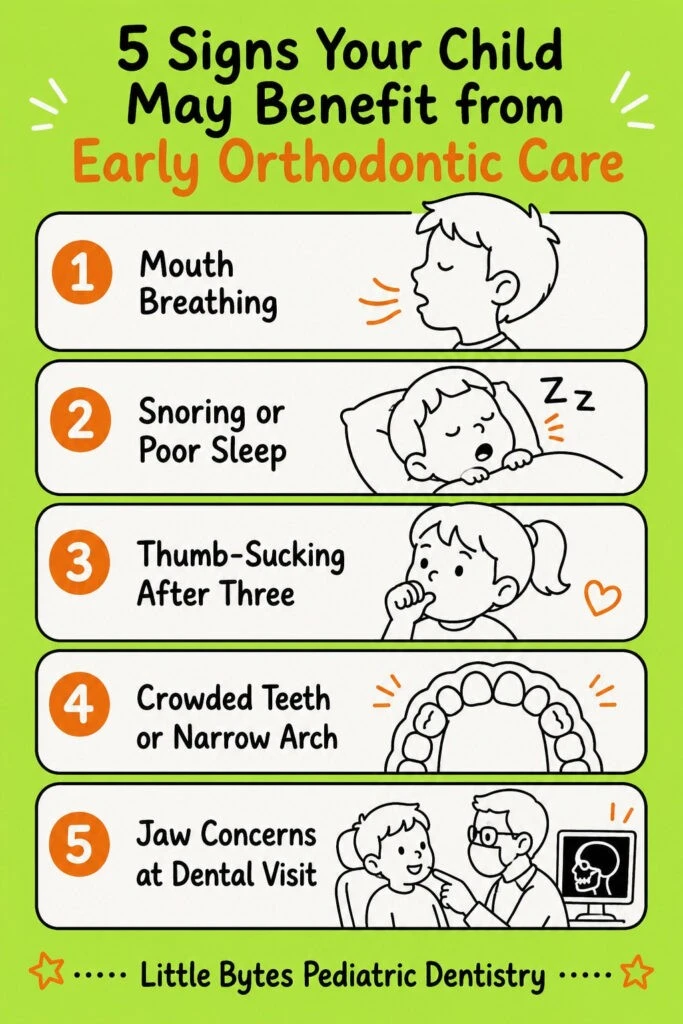
Some patterns in a young child are worth discussing with a pediatric dentist to determine whether early orthodontic intervention makes sense. Common indicators include the following:
- Mouth breathing is a regular habit during sleep and waking hours.
- Snoring, restless sleep, or other signs of sleep-disordered breathing.
- Thumb-sucking or prolonged pacifier use past age three.
- Noticeable crowding or a narrow upper arch in the baby teeth.
- Concerns about jaw development are identified during a routine dental exam.
A child showing several of these signs may be an ideal candidate for HealthyStart, particularly if treatment begins while the jaw is still in active growth.
How We Help You Find the Right Option
No two children develop the same way, which is why our team at Little Bytes evaluates each child individually before recommending any orthodontic path. We consider the stage of dental development, airway health, the presence of oral habits, and jaw growth patterns to determine which approach offers the most lasting result. Our minimally invasive dentistry philosophy means we always favor the most conservative, developmentally supportive option.
For some children, HealthyStart lays the groundwork so effectively that traditional braces may be unnecessary or significantly shorter in scope. For others, traditional braces at the appropriate age remain the right answer. In some cases, a combination of both produces the best long-term outcome.
Let Little Bytes Pediatric Dentistry Help You Decide
Our board-certified pediatric dentists in Palo Alto have completed extensive training through residency and volunteer outreach programs and hold privileges at Lucile Packard Children’s Hospital at Stanford and Kaiser Santa Clara. We use the latest dental technology, including intraoral cameras and digital X-rays, in a warm, child-friendly environment where every family feels informed and supported.
If you are weighing your child’s orthodontic options and want a thorough evaluation from a team that takes the time to understand your child’s individual development, we are ready to help. Schedule an appointment with our office today, and let us guide you toward the right path for your child’s smile and long-term oral health.