

Medically reviewed by
Dr. Michelle Haghpanah, DDS, MPH
Board-Certified Pediatric Dentist
Dr. Michelle Haghpanah is a board-certified pediatric dentist dedicated to providing preventive, evidence-based dental care for infants, children, and adolescents. She earned her Doctor of Dental Surgery from New York University, a Master of Public Health from Yale University, and completed her pediatric dental residency at Mount Sinai Medical Center, where she served as Chief Resident. A former Associate Professor at the University of the Pacific with hospital privileges at Lucile Packard Children’s Hospital Stanford and Kaiser Santa Clara, Dr. Michelle reviews clinical content to ensure it reflects current pediatric dental guidelines, evidence-based practices, and clear, family-friendly information that helps parents make informed decisions about their child’s oral health.
When most parents picture braces, they imagine a middle schooler with a mouth full of metal. So it can come as a surprise when a dentist suggests an orthodontic evaluation for a seven-year-old. The truth is that orthodontic treatment is not always a one-time event reserved for teenagers. For some children, starting early intervention, known as Phase 1 orthodontics, during the elementary years can make the entire treatment journey simpler, shorter, and more effective down the road.
At Little Bytes Pediatric Dentistry, Dr. Michelle Haghpanah and Dr. Grover take a proactive approach to children’s oral development. As board-certified pediatric dentists with privileges at Lucile Packard Children’s Hospital at Stanford, they understand that timing matters when it comes to setting kids up for healthy smiles that last a lifetime.
What Is Phase 1 Orthodontics?
Phase 1 orthodontics, sometimes called interceptive orthodontics, refers to early treatment that typically begins between the ages of 6 and 10, while a child still has a mix of baby and permanent teeth. The goal is not to achieve a perfectly aligned smile right away. Instead, it is to correct underlying structural or developmental issues before they become harder to treat.
Phase 1 treatment is not appropriate for every child. It is specifically recommended when a developing problem can be meaningfully improved by intervening early, rather than waiting until all permanent teeth have erupted.
Why Age 7 Is the Key Milestone
The American Association of Orthodontists recommends that all children have their first orthodontic evaluation by age 7. At this stage, enough permanent teeth have come in to give a trained clinician a clear picture of how the bite, jaw, and incoming teeth are developing. Many issues that seem subtle at age 7 can become significantly more complex if addressed only after all permanent teeth have arrived.
Common reasons a child might be referred for Phase 1 treatment include:
- Crossbites, where the upper and lower teeth do not meet properly
- Early loss of baby teeth that may affect spacing for permanent teeth
- Narrow jaw arches that could lead to crowding or breathing concerns
- Underbites or severe overbites that benefit from early jaw guidance
- Habits such as prolonged thumb-sucking that have altered jaw development
It is important to understand that an evaluation at age 7 does not automatically mean treatment. Many children are monitored over time and begin Phase 2 treatment in their teen years without ever needing Phase 1 intervention.
What Does Phase 1 Treatment Actually Involve?
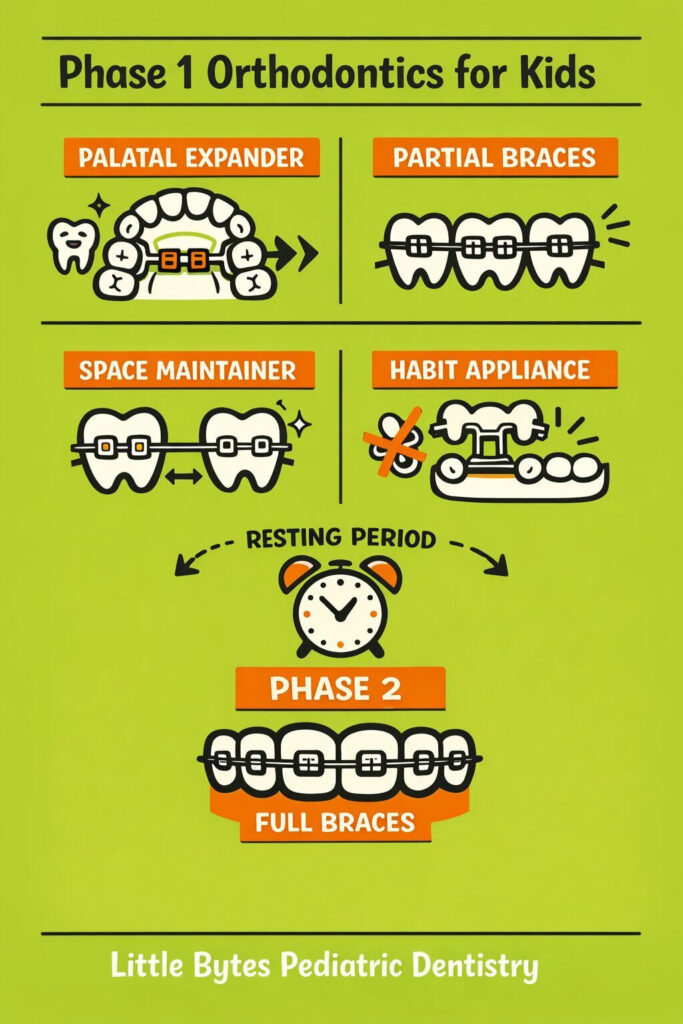
Depending on the child’s specific needs, Phase 1 treatment may include palatal expanders to widen the upper jaw, partial braces on select teeth, space maintainers to hold room for incoming permanent teeth, or habit-breaking appliances. These are not the same as a full set of braces. They are targeted tools designed to address a specific structural concern during a narrow window of development when the jaw is still actively growing and most responsive to guidance.
Phase 1 treatment is typically followed by a resting period before Phase 2, which is the full orthodontic treatment most people are familiar with. Children who complete Phase 1 often have shorter, more predictable Phase 2 treatment as a result.
How Pediatric Dentists and Orthodontic Care Connect
Pediatric dentists play a central role in identifying children who may benefit from early orthodontic evaluation. During routine dental exams, a pediatric dentist monitors jaw development, tracks the sequence of tooth eruption, and watches for bite irregularities that may warrant a closer look. This ongoing relationship means that potential concerns are rarely missed.
At Little Bytes, orthodontic care is part of a comprehensive approach to each child’s oral health. Whether a child needs monitoring, early intervention, or a referral for full orthodontic treatment, the team provides clear guidance so families always know where their child stands and what steps, if any, are appropriate.
Little Bytes Pediatric Dentistry: Starting Smart, Smiling Long
At Little Bytes Pediatric Dentistry, we believe that getting ahead of orthodontic issues early is one of the most valuable things a family can do for their child’s long-term oral health. Dr. Michelle, Dr. Grover, and Dr. Hollander bring both deep clinical expertise and a genuine commitment to individualized care, ensuring that every recommendation is grounded in what is right for your specific child, not a one-size-fits-all approach. Our Palo Alto practice is equipped with modern digital X-ray technology that allows us to see what is happening beneath the surface and make accurate, informed assessments.
If your child is approaching age 7 or if you have noticed something about their bite or jaw that seems off, we encourage you to bring it up at your next visit. Early conversations can make a real difference. Reach out to our team today to schedule an appointment.