
A Parent’s Guide to Pediatric Orthodontics in Palo Alto
Contents

Medically reviewed by
Dr. Michelle Haghpanah, DDS, MPH
Board-Certified Pediatric Dentist
Dr. Michelle Haghpanah is a board-certified pediatric dentist dedicated to providing preventive, evidence-based dental care for infants, children, and adolescents. She earned her Doctor of Dental Surgery from New York University, a Master of Public Health from Yale University, and completed her pediatric dental residency at Mount Sinai Medical Center, where she served as Chief Resident. A former Associate Professor at the University of the Pacific with hospital privileges at Lucile Packard Children’s Hospital Stanford and Kaiser Santa Clara, Dr. Michelle reviews clinical content to ensure it reflects current pediatric dental guidelines, evidence-based practices, and clear, family-friendly information that helps parents make informed decisions about their child’s oral health.
Medically Reviewed by Dr. Michelle Haghpanah on July 19, 2026
When a parent brings a seven-year-old in and mentions that their child has been biting on one side, or that their front teeth don’t quite meet, or that a sibling needed a lot of orthodontic work — that’s usually what brings them in for a first orthodontic evaluation. The American Association of Orthodontists recommends that evaluation by age seven, and in our experience, the families who come in around that time are the ones with the most options. The jaw problems we most often see in this age group are still growing problems, which means the window for the most efficient correction is open.
At Little Bytes Pediatric Dentistry in Palo Alto, Dr. Michelle Haghpanah and Dr. Reena Grover include orthodontic evaluations as part of routine pediatric care. We don’t wait for parents to notice a problem; we’re watching for the early signs at every cleaning.
What We’re Actually Watching for at Age Seven
The first question we get is usually some version of: “Why age seven? The teeth aren’t even all in yet.” That’s correct, and it’s actually the reason. We’re not evaluating teeth — we’re evaluating jaw development. By seven, the first permanent molars are typically in and enough front teeth are present to give us a working picture of how the bite is going to form. What we’re trying to catch early are the situations where jaw growth is headed somewhere we’ll want to redirect.
A crossbite is a good example. When the upper jaw is too narrow and the child closes their mouth, the teeth don’t mesh correctly — the jaw often shifts slightly to one side to compensate. Over a few years, that pattern can affect how the jaw itself develops. Caught at eight, a palate expander can widen the upper arch while the jaw is still growing and the fix is relatively straightforward. Caught at fourteen, the jaw has been compensating for six years and the correction is more complex and often incomplete.
We also look at spacing. Crowding — not enough room for the permanent teeth coming in — is the most common thing we flag. The other side of that is the child who has gaps where there shouldn’t be any, which can signal that a permanent tooth is either missing or impacted and won’t erupt on its own. Both are much easier to plan around when we know about them in second grade than when we find out in middle school.
Most kids we evaluate at seven or eight leave without a treatment plan. The evaluation establishes a baseline. A lot of families come back six months later, we check the same things, and we tell them everything is still on track. That’s the most common outcome.
What Actually Happens in an Early Orthodontic Appointment
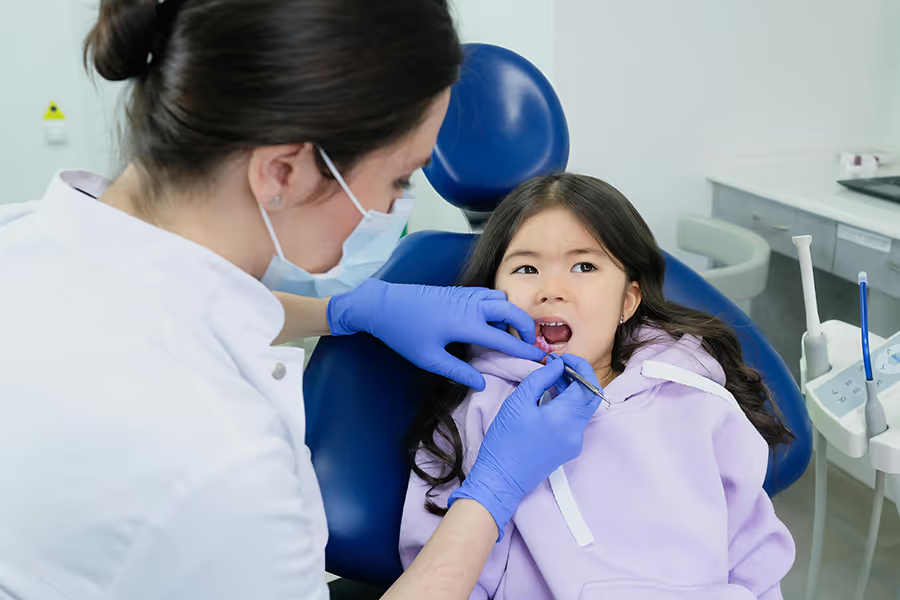
A first evaluation runs about 30 minutes. We look at the bite from the front and the side, check how the upper and lower arches relate, and review any x-rays we have on file. We’re checking for crossbites, crowding, spacing gaps, underbites, and whether any habits — thumb sucking, tongue thrusting — are affecting how things are developing. We’ll sometimes take a few new photos to have a clear baseline.
One thing parents often ask: do we take impressions or make molds? Not at an evaluation visit unless we’ve identified something that needs treatment and we’re planning how to address it. The first appointment is diagnostic. We’re forming a picture, not starting treatment.
Habits are worth their own conversation. A habit-breaking appliance is one of the most effective interventions we have for kids who still have a thumb or finger habit going into second grade. The appliance doesn’t punish the child for the habit — it changes what the habit feels like, so the drive to do it goes away. Done during active growth years, the structural correction that follows is much more complete. We’ve seen kids who got an appliance at seven have much better arch shape outcomes than comparable kids whose habits continued into their teens.
Phase 1 and Phase 2 — What Those Terms Actually Mean
Here’s a real version of how Phase 1 plays out. A child comes in at eight. We find a crossbite and a narrow upper arch. We place a palate expander. Over nine months, the arch widens. The crossbite resolves. We remove the expander and put the child on a monitoring schedule. She has some crowding in the front — that’s going to need braces eventually, once the adult teeth are in. So Phase 2 happens at thirteen. But the Phase 2 treatment is about alignment. The structural issue — the crossbite, the narrow arch — is already handled. We’re not doing two things at once.
Phase 1 treatment, done well, is targeted. We’re addressing the one thing that benefits from being corrected now. We’re not trying to finish the orthodontic picture in elementary school. The question we ask ourselves is: will this be meaningfully harder to address at fourteen than it is right now? If the answer is yes, that’s Phase 1 territory.
The other situation that calls for early treatment is the child who develops an underbite. The lower jaw growing ahead of the upper is a growth relationship issue, and there are appliances that work with the growth pattern to change that relationship. Those appliances stop working once the jaw growth is essentially complete — usually by the mid-teens. Parents who bring in an underbite at nine have options that parents of fifteen-year-olds don’t have. That’s the version of “early identification makes a real difference” that we see in practice.
The Appliances We Use, and Why We Choose Them
Palate expanders are our most-used Phase 1 tool. They’re fixed in place and work by applying gentle consistent pressure to the bones of the upper jaw. Because the palate hasn’t fused yet in childhood, it responds to that pressure by widening. Most kids adapt within a couple of weeks — they notice it at first, then stop thinking about it. The parents often ask “is that normal” about the gap that opens between the front teeth during expansion; it is, and it closes on its own.
Space maintainers are underutilized. When a baby molar is lost before the permanent tooth is ready to come in, the neighboring teeth drift into that space — it’s just what teeth do. A space maintainer holds the gap open so the permanent tooth has somewhere to go. It’s one of the simplest orthodontic interventions and one of the most effective at preventing the specific problem it’s designed to prevent.
For comprehensive alignment — full braces or clear aligners — we’re typically talking about Phase 2, with all or most of the permanent teeth in. Metal brackets are still the most precise option for complex cases. Clear aligners work well for the right candidate: an older child or teen who is consistent about wearing them and whose alignment needs fit the aligner format. They’re not a universal substitute for braces.
What Happens at the Consultation Visit
The evaluation itself, we’ve described. The conversation afterward is what most parents are there for. We walk through what we found, what we think it means, and what we’d recommend. In the cases where we’re recommending treatment, we explain specifically what we’d do and why doing it now produces a better result than waiting. In the cases where we’re recommending watching, we explain what we’re watching for and when we’d want to see the child again.
Parents sometimes ask whether we have an incentive to recommend early treatment. The honest answer is that we don’t — and our practice pattern reflects that. We see a lot of children for evaluation who don’t end up in treatment until their teens, if at all. The goal of the seven-year evaluation is to identify the situations where earlier is genuinely better, not to fill appointment slots with Phase 1 cases.
Dr. Haghpanah and Dr. Grover are both board-certified pediatric dentists maintaining privileges at Lucile Packard Children’s Hospital at Stanford and Kaiser Santa Clara. We see children from infancy through adolescence, which means orthodontic evaluations are part of a longer-term picture of each child’s development rather than a one-time consult in isolation.
Schedule an Orthodontic Evaluation at Little Bytes in Palo Alto
If your child is around seven and hasn’t had a first orthodontic evaluation, or if you’ve noticed something in how they bite or how their teeth are coming in, we can take a look and tell you clearly where things stand. Early evaluation doesn’t mean early treatment. It means early information — and in the situations where the information points to a problem, we’d rather know now. Contact us to schedule at our Palo Alto office.
Frequently Asked Questions About Pediatric Orthodontics in Palo Alto
The American Association of Orthodontists recommends a first evaluation by age seven. By that point the first permanent molars are typically in and enough front teeth are present to evaluate jaw development, bite alignment, and arch width. Many children evaluated at seven need no treatment at all — the visit establishes a baseline and tells us whether things are on track.
Not at all. Most children we evaluate at seven or eight leave without a treatment plan. The most common outcome is that we tell the family everything is developing normally and put the child on a monitoring schedule. An early evaluation that finds no problem is a useful outcome — you know where things stand and aren’t waiting to find out in middle school.
Phase 1 is early orthodontic treatment for children who still have a mix of baby and adult teeth, typically between ages 6 and 10. It addresses a specific problem — a crossbite, a narrow arch, a habit affecting jaw development — while the jaw is still actively growing. Phase 1 doesn’t replace full braces later; it handles the structural issue so that Phase 2 (full alignment treatment) is shorter and simpler than it would have been otherwise.
A palate expander is a fixed appliance that gradually widens the upper jaw by applying consistent gentle pressure to the palate bones, which haven’t fully fused yet in childhood. We use it when the upper arch is too narrow relative to the lower — a situation that causes crossbites and leaves insufficient room for incoming permanent teeth. Adaptation usually takes a week or two. A gap opens between the front teeth during expansion and closes on its own once the expander comes out.
Usually yes, and timing matters. An underbite involves the lower jaw growing ahead of the upper, which is a jaw relationship issue. There are appliances that work with the growth pattern to redirect that relationship — but they only work while the child is still actively growing. Once jaw growth is essentially complete, typically by the mid-teens, those tools are no longer effective. Families who bring in an underbite at nine or ten have options that aren’t available to a fifteen-year-old with the same jaw relationship.
About the Author
Dr. Michelle Haghpanah
Little Bytes Pediatric Dentistry — Palo Alto, CA
Dr. Michelle Haghpanah is a board-certified pediatric dentist at Little Bytes Pediatric Dentistry in Palo Alto. She maintains privileges at Lucile Packard Children’s Hospital at Stanford and Kaiser Santa Clara and provides comprehensive pediatric dental care including orthodontic evaluations, preventive care, and full-service treatment from infancy through adolescence.